
 Publishing
Every song counts.
Every share adds up.
Administer copyrights end to end with melino. Register works and their splits, file them with the societies over CWR, take in what your partners report, and account it back out as statements.
Every song counts.
Every share adds up.
A writer with two hundred works and a group with eight sub-publishers ask the same software for different things. melino is built for both.
Better Days
ISWC T-931 452 077-8
J. Park
Composer
L. Cruz
Lyricist
A. Rua
Composer
Pine & Hollow
Publisher
Works
Every share, and they add up to 100
The split sheet, made arithmetic
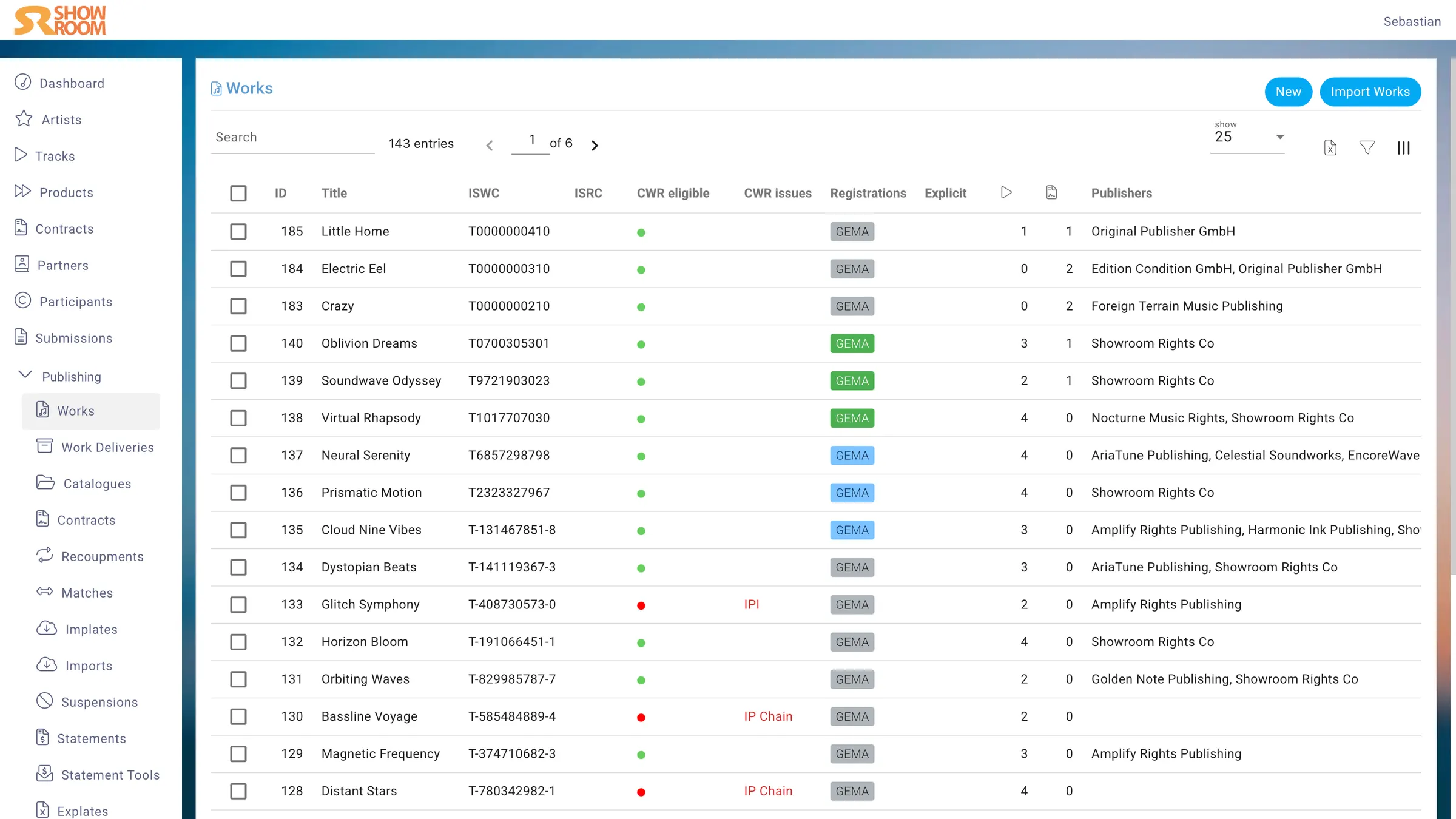
A Work holds its title and alternate titles, its ISWC, and every participant on it — composers, lyricists, arrangers and publishers — each with their share per income source. The shares have to sum to 100% across the participants, so the deal a statement is calculated from is the deal that was agreed rather than a spreadsheet that drifted from it.
Shares validated
10:04 AMCWR 3.0 generated
10:04 AMFiled with GEMA
10:06 AMRegistrations: Generate CWR, file it, done.
Filed with the societies, not typed into their portals
Export a work — or the whole catalogue — as CWR, in the version and for the territory the society expects. melino checks eligibility first and shows what is missing, so a file comes back registered rather than rejected for an absent IPI. Registration status is tracked per collecting agency, and Editions carry the IP Name Numbers the files are filed under.
Legacy 2010–2015
Catalogues
Group once, contract in one move
Name a group of works once, use it everywhere
A Catalogue is a named collection — the 2010–2015 legacy repertoire, a writer's output, an acquired list — and a contract takes the whole of it at one share rather than the works one by one. Composers and publishers are derived from what is in it, so a catalogue describes itself.
Contracts
Shares, territories and channels
| Stream | Down. | Phys. | Sync | |
|---|---|---|---|---|
| World | 50% | 50% | 45% | 60% |
| DE / AT / CH | 60% | 60% | 55% | 70% |
| US | 50% | 50% | — | 55% |
Shares, territories and channels, in one agreement
A Contract names the partner, the works or catalogues it covers and what each is worth, with terms per territory and per channel — streaming, download, physical, sync — and reductions where they apply. Advances are booked against it and offset the payouts that follow, and the signed PDF is filed on the record it belongs to.
Implates
Every partner’s file, mapped once.
Every partner's spreadsheet, mapped once
No two partners send the same columns. An Implate maps one partner's file format to melino's fields — header by header, spaces and encoding and all — and attaches to the partners who send it, so the next file arrives already understood. Set it up once; every period after that is an upload.
Copyright Administration
Register, contract, import, account.
Four acts, in the order they happen — one work, from the split sheet that created it to the statement that pays it out.
Step 1: Register
The composition, its writers, and what each of them owns.

Create the work
Works
Enter participants and shares
Works
Assign the imprint and IP Name Number
Editions

Export to CWR
Works
Step 2: Contract
The deals the catalogue is licensed and paid under.
Group the works
Catalogues
Onboard the partner
Partners
Set terms by territory and channel
Contracts
Book the advance
Contracts
Step 3: Import
Money in from every source, checked before it counts.

Partner delivers the royalty file
Imports

Map the file format
Implates
Resolve the rows that did not match
Suspensions
Mark the import checked
Imports
Step 4: Account
Rated, exported, sent, and closed for good.
Generate for the period
Statements
Reconcile across partners
Stmt Tools
Export and send
Explates
Partner receives the statement
Statements
Your team does this in melinoYour partner sends and receivesThen the period closes.
Royalty data in from every source, validated before it counts, rated against the contracts, and out again as statements your partners can read.

Every figure leads back to the split sheet.
A line on a statement leads back to the split sheet
Works, shares, contracts, imports and statements are one chain rather than five systems that have to be reconciled. A figure in a payout can be opened back through the contract term that rated it, the import row that earned it, and the participant share on the work behind it.
That is what makes a query from a writer a two-minute answer rather than an afternoon in a spreadsheet — and what makes an audit something you can survive.
Imports
Checked on the way in, not after.
Validated before it counts
A partner's royalty file is checked against their Implate on the way in: rows that map cleanly are valid, the rest are suspended for someone to look at. Disputes are resolved on the import itself, exchange rate and currency are recorded with it, and nothing reaches a statement until the import is marked checked.
Partners
Who pays you, and who you pay
Sony Music Publishing
Balances under the threshold carry to the next period.
Income sources and payees, in one record
A Partner is whoever sends royalty data in or takes a payment out, and most are both. Banking details, VAT number and currency live on the record; so do the accounting cadence their statements follow and the minimum payout below which a balance is carried to the next period rather than paid.
Explates
One run, two ways to read it
Two views of the same statement
An Explate decides which columns a statement file carries and how they are formatted — widths, number and date formats, alignment, order. Keep a plain one for partners and a fuller one with the working columns for your own desk, and generate both from the same run.
Statements
Generated, read five ways, then locked.
Generated, read five ways, then locked
Pick a company, a partner and a period, and melino rates the validated income against the contracts, applies advances, opening balances and recoupments, and arrives at the payout. Read the result by channel, contract, territory, work or source; export it as PDF, XLSX or the whole bundle; send it, and lock it so the period cannot move under you afterwards.