
· 5 min read
What Goes Into a Royalty Statement (And What to Check Before You Send One)
A royalty statement is one of the most important documents in the music business.
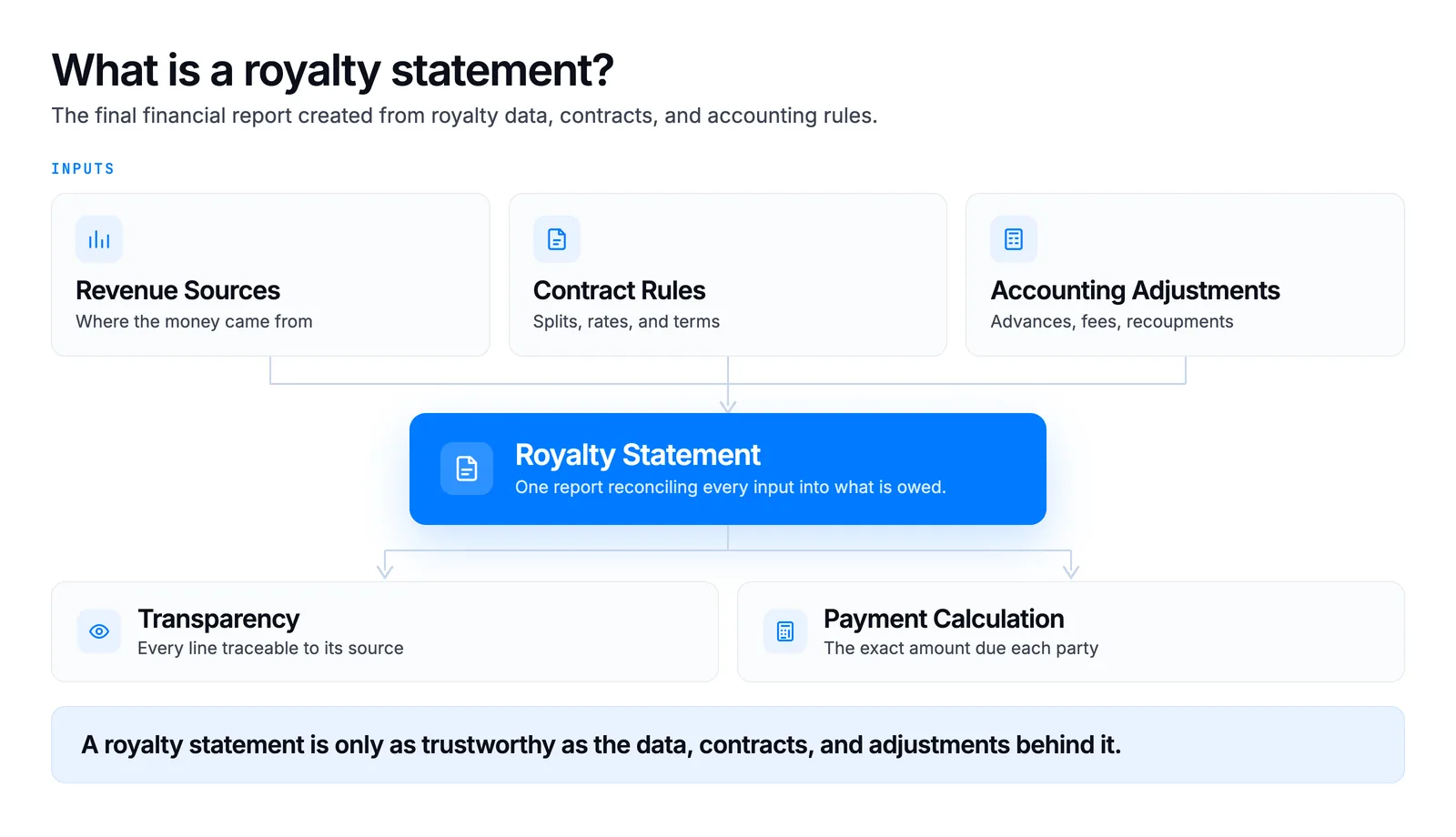
A royalty statement is one of the most important documents in the music business.
For artists, songwriters, publishers, and other rights holders, it is the document that explains what revenue was earned, how it was calculated, and how much money is ultimately payable.
For labels and publishers, a royalty statement is much more than a payment summary. It is the final result of months of reporting, royalty collection, contract administration, and financial processing.
A good royalty statement should answer three simple questions:
- Where did the revenue come from?
- How was it allocated?
- How was the final payable amount calculated?
The clearer those answers are, the easier it becomes to build trust and avoid unnecessary disputes.
What Is a Royalty Statement?
A royalty statement is a financial report that summarizes earnings and calculations for a specific accounting period.
Depending on the business model, statements may be issued monthly, quarterly, semi-annually, or annually. They typically include revenues collected during a defined reporting period and explain how those revenues were shared between different stakeholders.
At its core, a royalty statement serves two purposes:
- To provide transparency.
- To document financial obligations.
Whether the recipient is an artist, songwriter, producer, publisher, or investor, the statement should clearly show how the final numbers were reached.
Revenue Information
The foundation of every royalty statement is revenue.
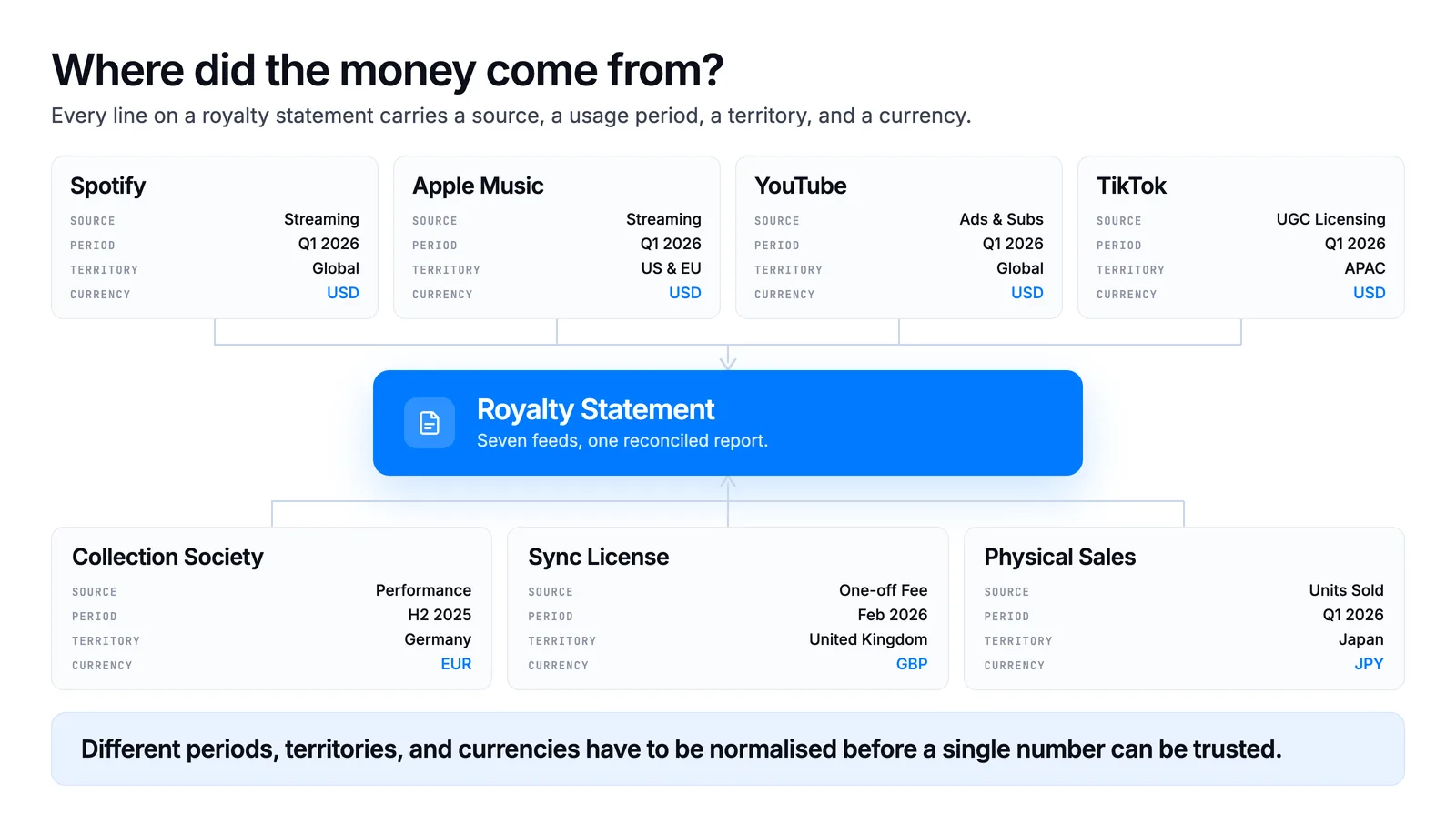
Before any royalties can be calculated, the statement needs to clearly identify where the money came from.
This usually includes information such as:
- Revenue source
- Usage period
- Reporting period
- Territory
- Currency
- Product or recording
For example, a statement may contain revenue from:
- Spotify
- Apple Music
- YouTube
- TikTok
- Collection societies
- Sync licenses
- Physical sales
Simply showing a total amount is rarely enough.
A recipient should be able to understand where the revenue originated and which activities generated the income.
The more transparent the revenue section is, the easier it becomes to validate results and answer questions later on.
Ownership and Contract Information
Revenue alone does not determine who gets paid.
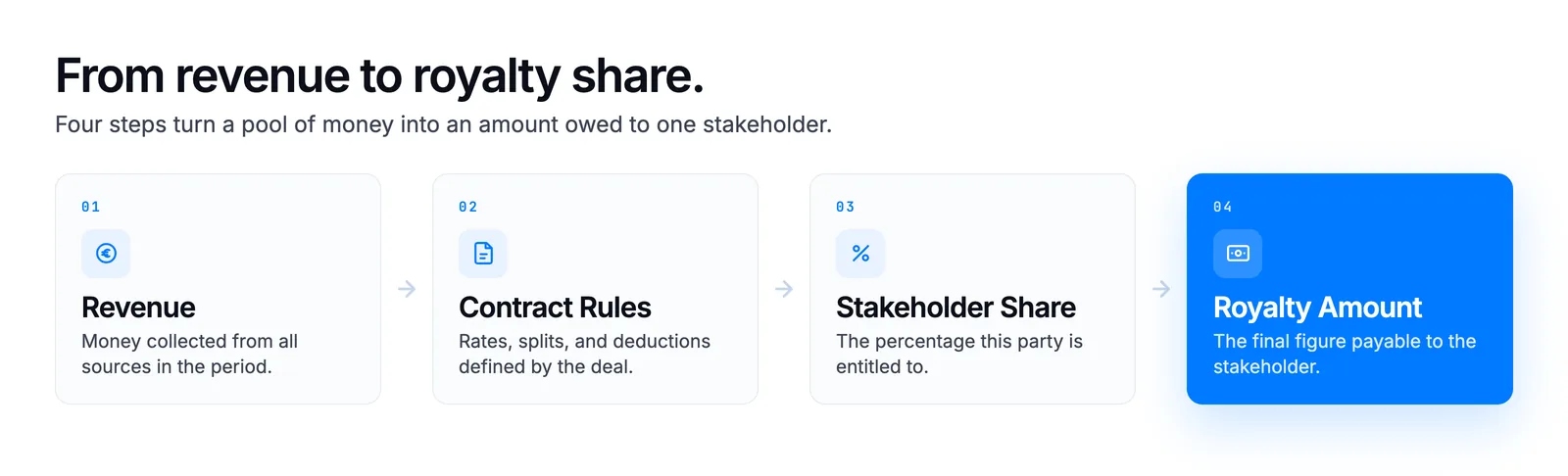
The next step is applying ownership information and contractual agreements.
Two people looking at the same revenue line may receive completely different results depending on their contractual relationship.
A royalty statement typically reflects:
- Ownership percentages
- Participation shares
- Revenue splits
- License agreements
- Contract terms
For example, if a track generates €1,000 in royalties and a rights holder is entitled to 25%, their royalty calculation begins with that contractual share.
Without contract information, revenue is simply revenue.
Contracts determine how that revenue is allocated.
Recoupments and Deductions
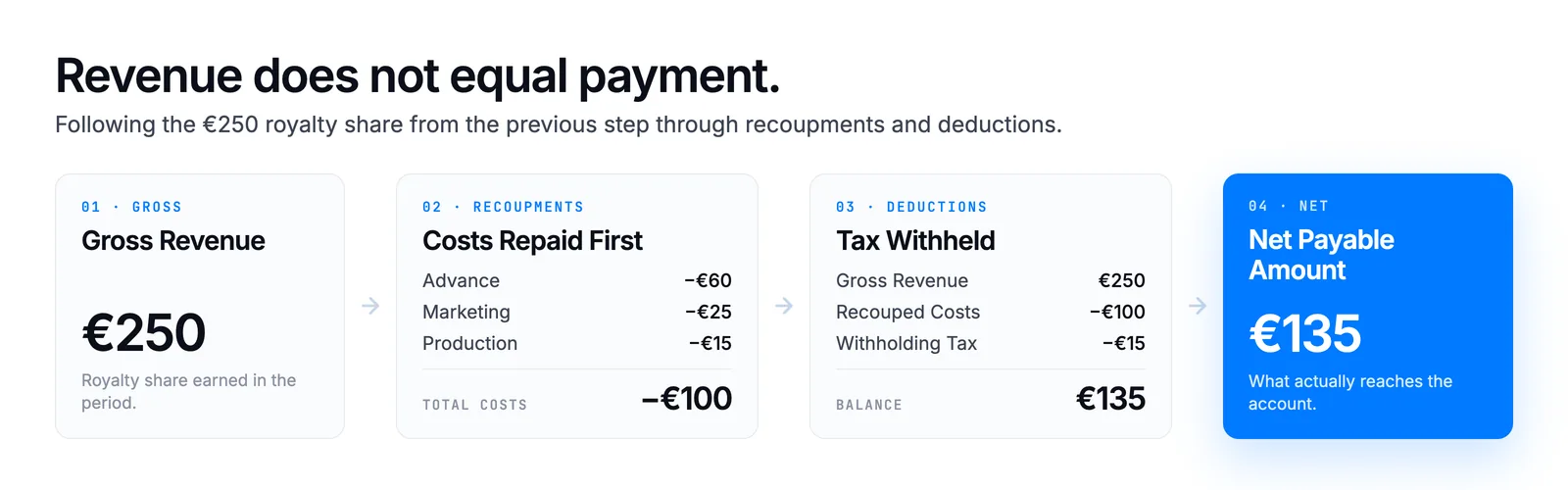
One of the most misunderstood parts of a royalty statement is the difference between revenue and payable royalties.
Generating revenue does not automatically mean money is available for distribution.
Many agreements contain recoupment provisions that require costs or advances to be recovered before payments are made.
Common examples include:
- Artist advances
- Marketing expenses
- Production costs
- Manufacturing costs
- Tour support
- Other contractually agreed expenses
Statements may also contain deductions such as:
- Distribution fees
- Administration fees
- Withholding taxes
- Collection fees
As a result, two statements showing the same revenue can produce very different payment amounts.
A good statement should make all deductions transparent and easy to follow.
Currency and Territory Information
Music is a global business.
A single catalog may generate income from dozens of countries and multiple reporting currencies at the same time.
For that reason, royalty statements should clearly explain:
- Original reporting currencies
- Conversion methodology
- Reporting currency
- Territories where revenue was generated
This information becomes particularly important when evaluating market performance or reconciling payments across multiple revenue sources.
The goal is consistency.
Every stakeholder should be able to understand how international revenue was translated into the final statement.
What to Check Before You Send a Royalty Statement
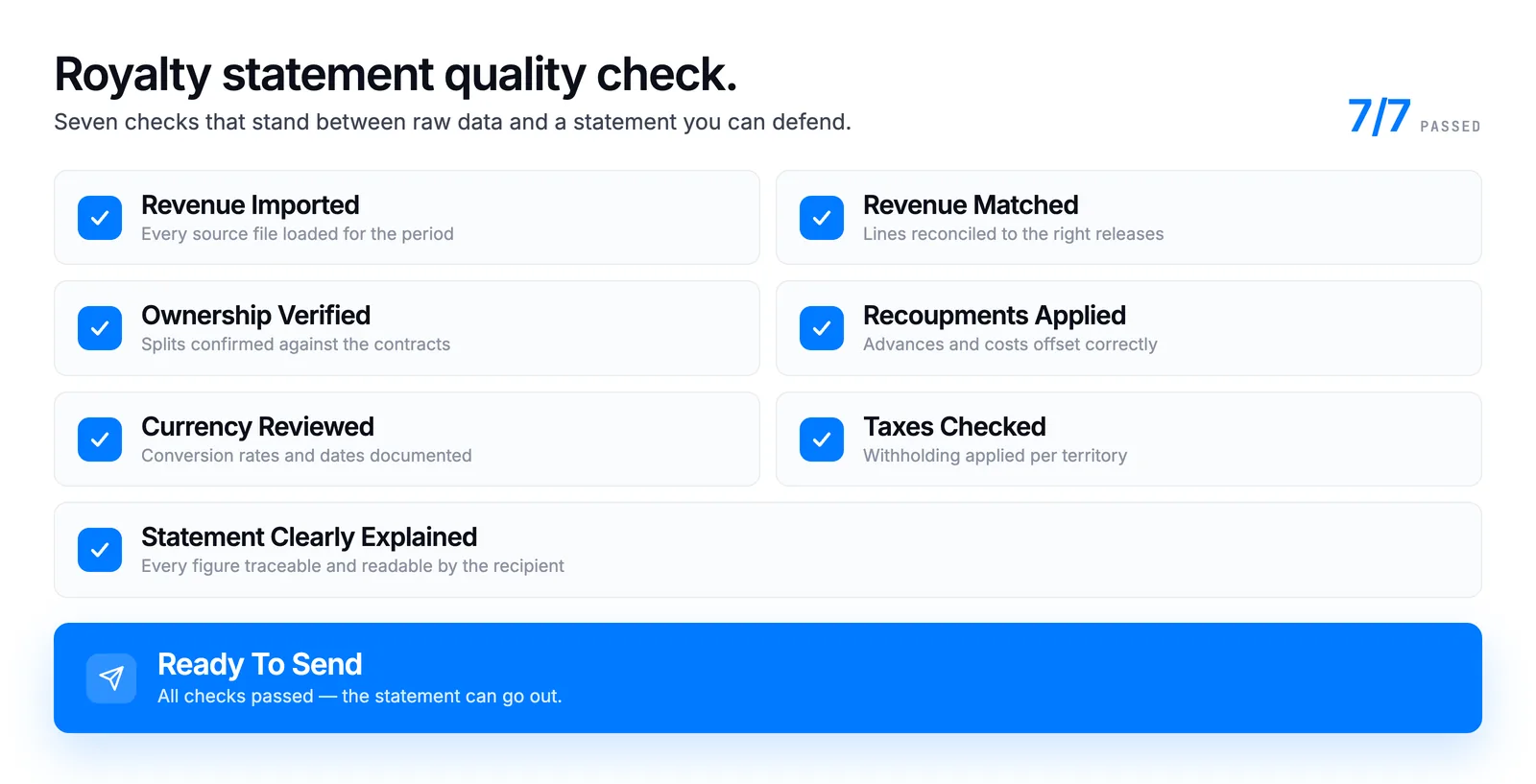
Before a statement is shared with artists, songwriters, or other rights holders, several quality checks should be completed.
A small mistake can create unnecessary support requests, disputes, or payment delays.
Some of the most important questions include:
Has all revenue been imported?
Missing reports can result in incomplete statements.
Has the revenue been matched correctly?
Revenue should be connected to the correct recordings, works, and rights holders.
Are ownership shares accurate?
Incorrect percentages can affect every downstream calculation.
Have recoupments been applied correctly?
Advances and costs should follow the contract terms.
Are currency conversions consistent?
The same revenue should not produce different results because different exchange rates were used.
Have taxes and withholding obligations been considered?
International payments often require additional compliance checks.
Does the statement clearly explain the outcome?
The recipient should be able to understand how the final payable amount was reached. Transparency is not just a reporting feature. It is a quality-control mechanism.
Conclusion
A royalty statement is more than a document. it is the final output of the entire royalty process.
Every stream, download, broadcast, sync placement, collection-society distribution, contract term, deduction, and payment rule ultimately finds its way into a statement. The better the underlying data, contracts, and accounting processes, the more accurate and transparent the result becomes.
For rights holders, that means understanding. For labels and publishers, it means confidence that the numbers can stand up to scrutiny.