
· 8 min read
What Are Music Royalties? A Complete Guide for Labels and Publishers
Music royalties are the financial engine of the music industry.
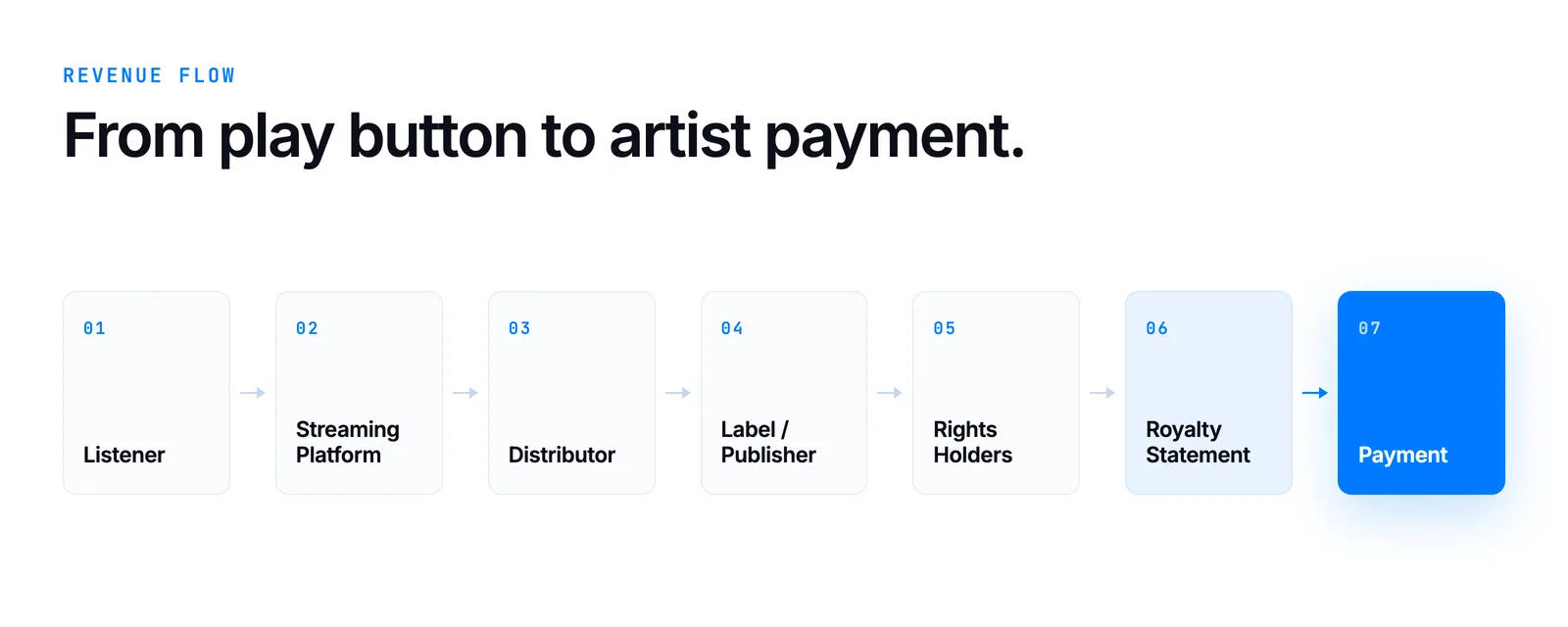
Music royalties are the financial engine of the music industry.
Every time a song is streamed, downloaded, played on the radio, performed live, used in a TV commercial, featured in a social media post, or synchronized to a film, value is created. Royalties are the mechanism through which that value is distributed to the people and companies that own, control, or participate in the rights behind the music.
The concept is straightforward: music is used, revenue is generated, and rights holders get paid. The reality is more complex.
Before a payment reaches an artist, songwriter, publisher, producer, or label, revenue often passes through streaming platforms, distributors, collecting societies, licensing partners, accountants, and reporting systems. Understanding how this ecosystem works is essential for anyone involved in label management, music publishing, rights administration, or royalty accounting.
What Are Music Royalties?
Music royalties are payments made to rights holders when music is used commercially.
These payments can arise from many different activities, including streaming, downloads, physical sales, public performances, social media usage, and synchronization licensing.
The purpose of royalties is simple: creators and owners of music rights should participate financially whenever their music generates value.
However, a single song can have multiple owners, multiple contractual participants, and multiple revenue streams. This means that a single usage event can generate several separate royalty payments.
A song streamed on Spotify, for example, may create revenue for:
- The owner of the sound recording
- The performing artist
- The songwriter
- The publisher
- Other contractual participants
That is why music royalties sit at the intersection of creativity, rights ownership, contracts, and business operations.
Who Receives Music Royalties?
Many people assume royalties only go to artists. In reality, music royalties are distributed across a much wider ecosystem of stakeholders.
Depending on ownership structures and contractual agreements, royalties may be paid to:
- Record labels
- Recording artists
- Songwriters
- Publishers
- Producers
- Featured artists
- Remixers
- Rights holders
- Estates and catalog owners
The exact recipients depend on which rights are involved and how those rights have been contractually assigned. This distinction leads to one of the most important concepts in the music business.
The Two Rights Ecosystems Behind Every Song
Every song consists of two separate rights ecosystems.
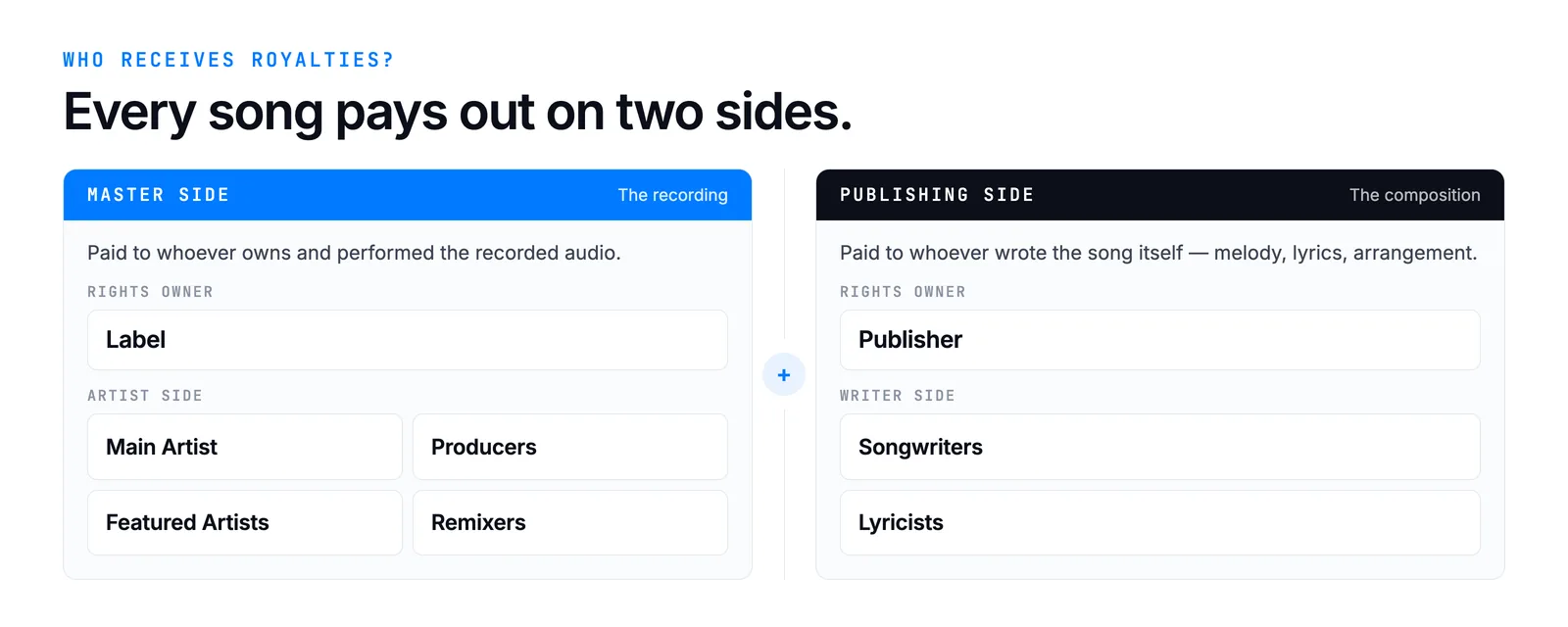
Master Rights
Master rights relate to the sound recording itself. This is the recorded performance that listeners hear on Spotify, Apple Music, YouTube, radio, or physical products.
Master rights are typically controlled by:
- Record labels
- Independent artists
- Recording owners
- Investors who have acquired catalogs
Revenue generated from the recording generally flows through the master rights side.
Publishing Rights
Publishing rights relate to the underlying composition.
This includes:
- Melody
- Lyrics
- Musical arrangement
Publishing rights are generally controlled by:
- Songwriters
- Composers
- Publishers
Revenue generated through use of the composition flows through the publishing side.
One Song, Two Revenue Systems
This means a single song can create financial value in two different ways at the same time.
When a song is streamed:
- The recording generates master income.
- The composition generates publishing income.
That is why labels and publishers often participate in the same usage event while operating within different rights structures. Understanding this distinction is the foundation of royalty administration.
How Music Royalties Are Generated
Music royalties are generated through different forms of music consumption and licensing.
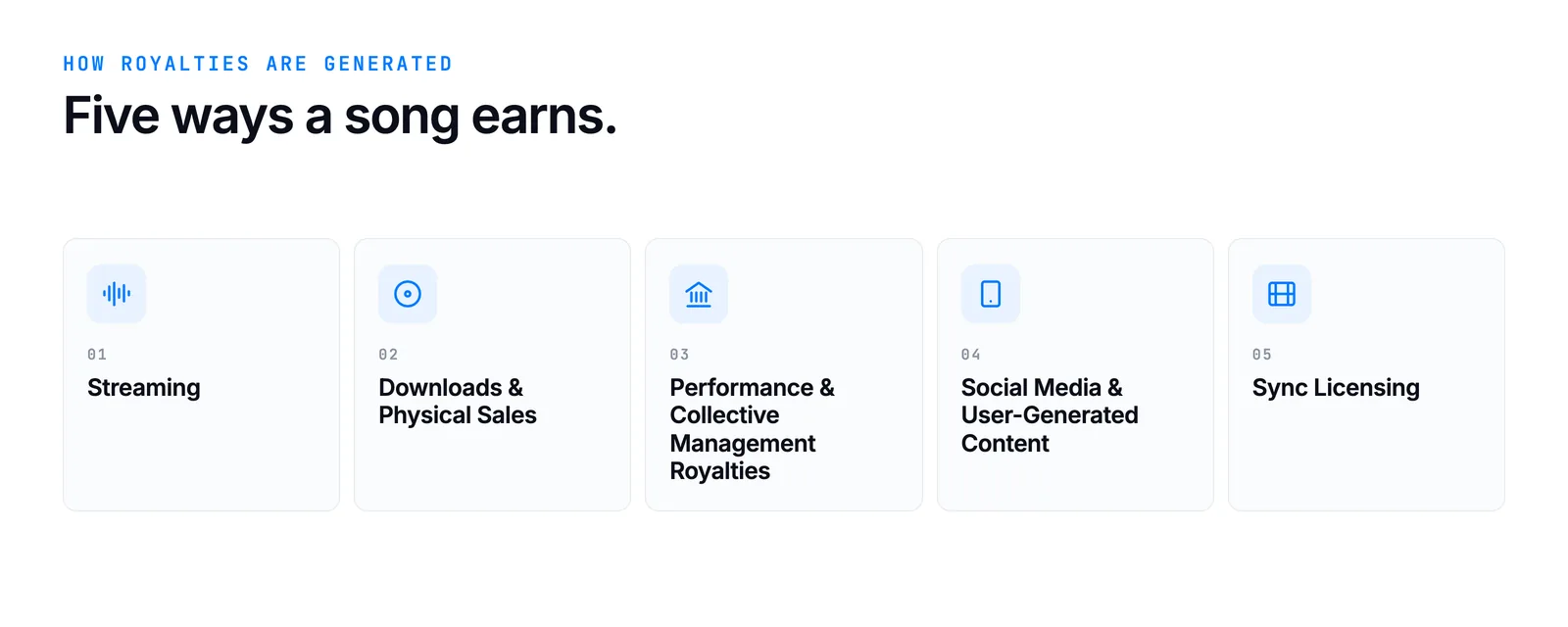
Streaming
Streaming platforms such as Spotify, Apple Music, Amazon Music, and Deezer have become the dominant revenue source for much of the industry. Every stream contributes to royalty pools that are distributed among rights holders.
Downloads & Physical Sales
Although usually smaller than streaming today, downloads and physical formats remain important for many catalogs.
Examples include:
- Vinyl
- CDs
- Digital downloads
- Direct-to-fan sales
These revenues may generate both master and publishing income.
Performance & Collective Management Royalties
Music is performed far beyond streaming services.
Royalties can be generated when music is:
- Broadcasted on radio
- Played on television
- Performed live
- Used in public venues
- Played in commercial environments
These revenues are frequently collected and distributed through collecting societies and neighboring rights organizations.
Social Media & User-Generated Content
Platforms such as:
- TikTok
- YouTube
have become major licensing and revenue channels.
Music integrated into user-generated content may generate revenue depending on licensing agreements and platform arrangements.
Sync Licensing
Synchronization licensing allows music to be used together with visual media.
Examples include:
- Films
- TV series
- Advertisements
- Games
- Corporate productions
Unlike many royalty streams, sync income is often directly negotiated and frequently involves both recording and publishing rights.
Who Collects Music Royalties?
Not every royalty reaches rights holders directly. In fact, some of the industry's greatest challenges exist within the collection process itself. Revenue typically passes through several intermediaries before reaching its final recipient.
Distributors
Distributors collect revenue from digital platforms and retailers. They consolidate revenue reports and transfer income to labels and rights holders.
Collection Societies
Collection societies are responsible for administering specific royalty streams on behalf of their members.
Examples include:
- GEMA
- ASCAP
- BMI
- PRS
- SACEM
- GVL
- PPL
These organizations play a central role in collecting and distributing performance and neighboring-rights income.
Publishers
Publishers often administer publishing royalties and coordinate registrations, collections, and reporting processes for songwriters and composers.
Licensing Partners
Sync agencies, sub-publishers, neighboring-rights agencies, and licensing organizations may also participate in the royalty collection process.
The result is a highly interconnected ecosystem where money can arrive through multiple channels simultaneously.
Why Royalty Administration Is More Complex Than It Looks
At first glance, a song appears to be a simple product. In reality, commercial music exploitation creates layers of complexity.
A single song may generate revenue through:
- Multiple DSPs
- Multiple territories
- Multiple currencies
- Multiple contracts
- Multiple stakeholders
- Multiple royalty types
Data associated with these revenue streams often arrives in different formats, at different times, and from different sources.
Before anyone gets paid, that information typically needs to be matched, reconciled, verified, allocated, and reported. As catalogs grow, complexity increases exponentially. This is the point where many music companies discover that understanding royalties and managing royalties are two very different things.
A Modern Royalty Workflow
Most people associate royalty administration with statements and payments. In practice, those are only the final stages of a much larger workflow.
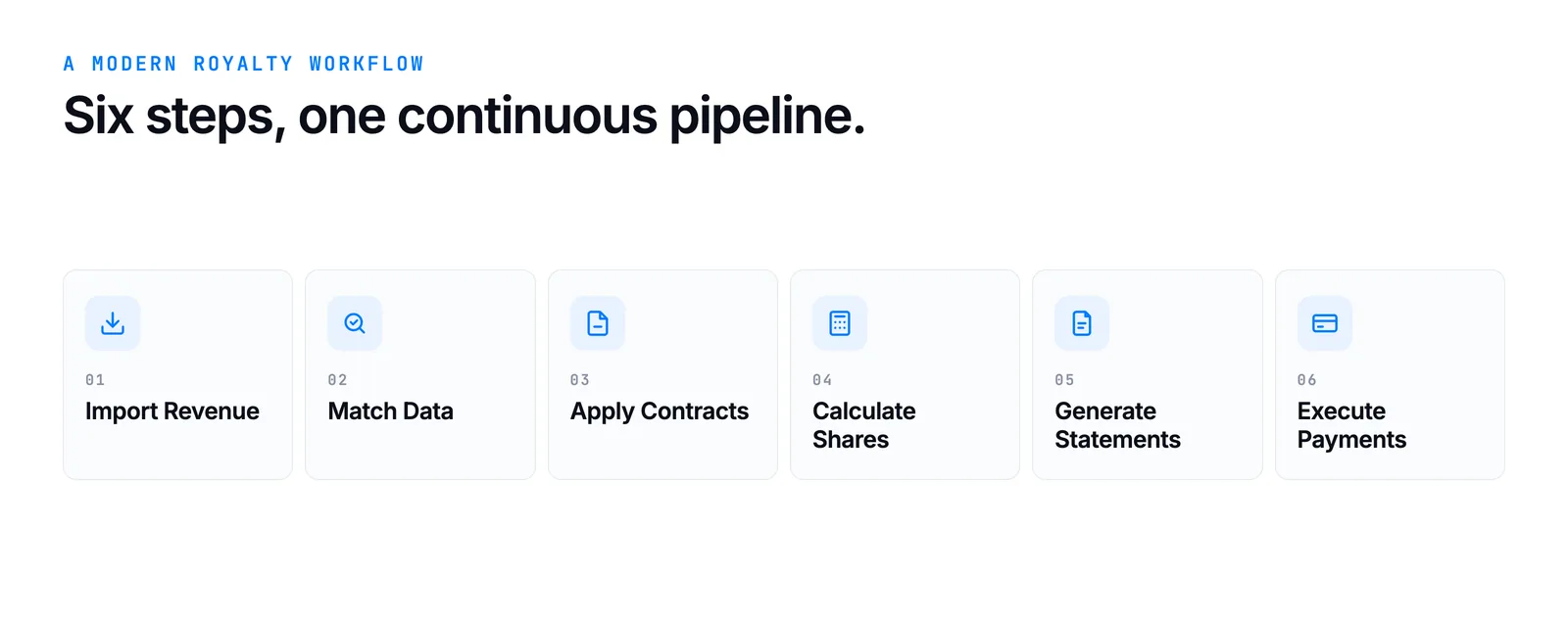
A modern royalty workflow typically consists of six stages:
1. Import Revenue
Revenue data enters the system from distributors, collecting societies, licensing partners, and other sources.
2. Match Data
Incoming revenue is matched against recordings, compositions, products, contracts, and rights holders.
3. Apply Contracts
Ownership structures, participation percentages, royalty rates, and contractual conditions are applied.
4. Calculate Shares
Revenue is distributed among all participants according to the relevant agreements.
5. Generate Statements
Royalty statements are created to document earnings and distributions.
6. Execute Payments
Approved royalties are paid to the relevant rights holders.
For a small catalog, these activities might be manageable manually. For a growing label or publisher, they quickly become a highly specialized operational discipline.
Why Modern Royalty Operations Need Infrastructure
Understanding royalties is important. Managing them efficiently is a different challenge altogether.
Successful labels and publishers rely on:
- Accurate metadata
- Structured contract information
- Reliable rights ownership data
- Consistent reporting workflows
- Transparent statements
- Efficient payment processes
Without those foundations, growth often creates friction rather than opportunity. Modern music businesses increasingly depend on centralized infrastructure that connects catalog data, rights information, accounting, statements, reporting, and payments into one coherent workflow.
Conclusion
Music royalties are the mechanism through which financial value flows through the music industry. Every stream, sale, performance, broadcast, synchronization, and social media use creates potential revenue that must ultimately be distributed to the appropriate rights holders.
While the concept of royalties is relatively simple, the systems required to administer them are far more complex. Multiple rights structures, multiple collection channels, multiple stakeholders, and multiple revenue streams all contribute to an ecosystem that demands clarity and organization.
Understanding royalties is the first step. Building reliable workflows around them is the next. For modern labels, publishers, and rights holders, successful royalty administration is no longer just about calculations. It is about creating the infrastructure that turns complexity into confidence.
Looking Beyond Royalties?
Royalties are only the beginning. The next challenge is understanding how music revenue travels from streaming platforms, collecting societies, distributors, and licensing partners all the way to statements and payments.
Next article: How Are Music Royalties Collected? From DSPs to Your Bank Account