
· 9 min read
The 4 Types of Music Royalties Every Label Should Track
Music royalties are often discussed as if they were a single source of income.
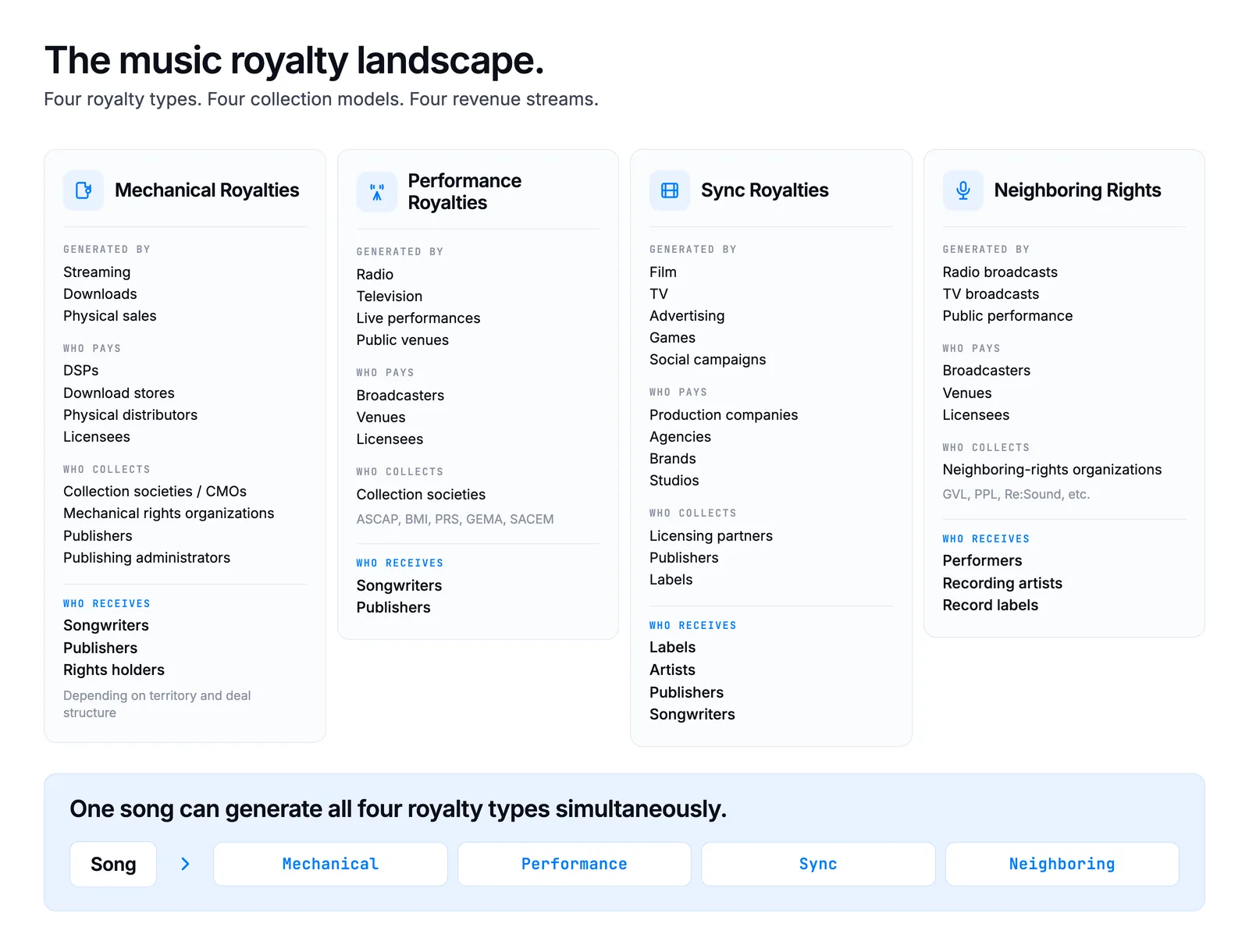
Music royalties are often discussed as if they were a single source of income.
In reality, the term music royalties covers several distinct revenue streams, each generated by different types of music usage, collected through different channels, and distributed to different rights holders.
A song streamed on Spotify generates a very different royalty flow than a radio broadcast, a TV commercial, or a physical vinyl sale. Some royalties are paid to recording owners and performers, others to songwriters and publishers. Some are collected by distributors, while others are administered through collecting societies, publishers, or licensing partners.
For labels, publishers, and rights administrators, understanding these distinctions is essential. Not because the terminology is complicated, but because each royalty type follows its own set of rules, reporting cycles, and collection mechanisms.
Before diving into each category individually, let's look at the four major royalty streams that drive revenue in today's music industry.
One Song Can Generate Multiple Royalties
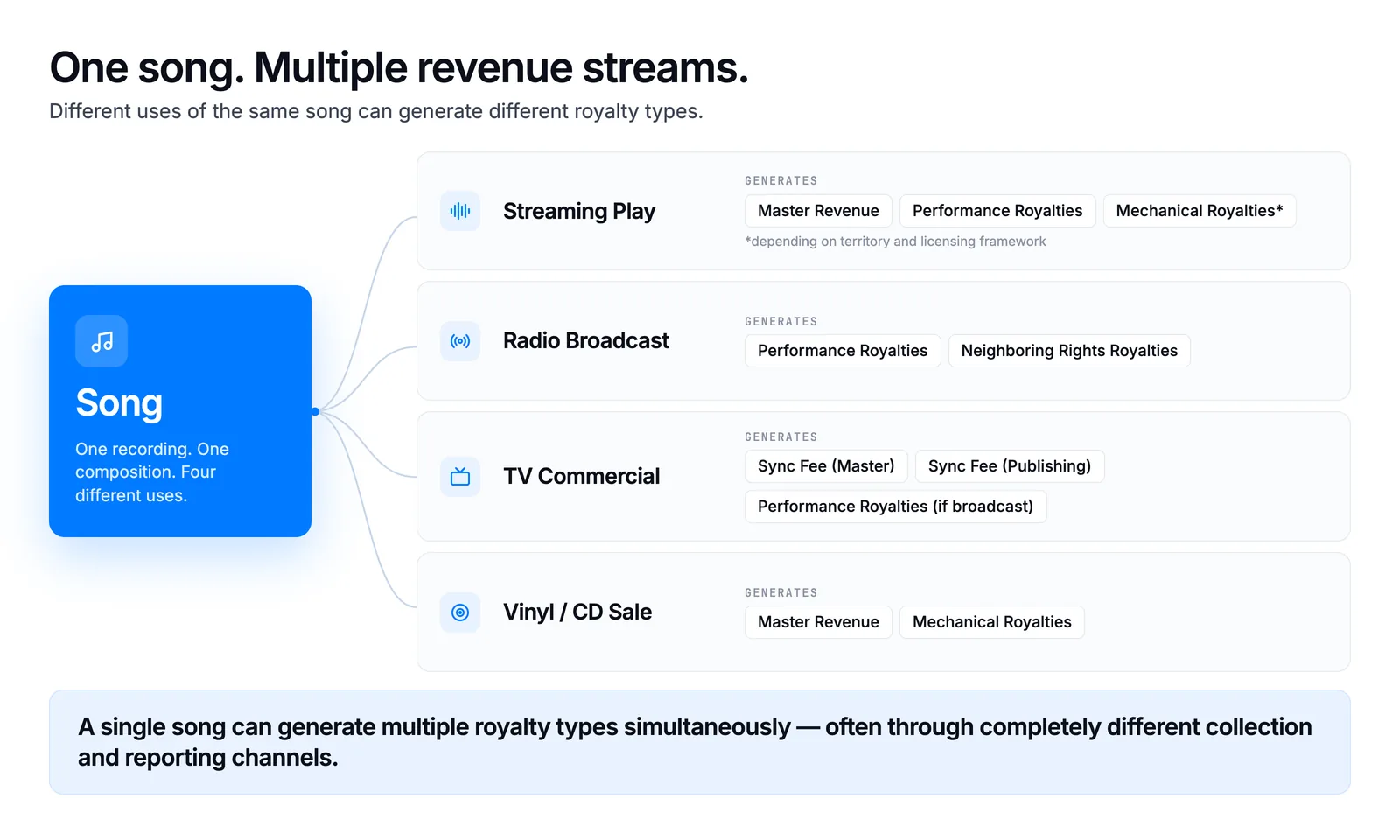
One of the biggest misconceptions is the assumption that a song generates a single royalty stream. In reality, the same song can create multiple types of revenue at the same time, depending on how it is used.
Every royalty type exists because a different right is being exploited. Some royalties are linked to the recording itself, while others are linked to the underlying composition. Some are triggered by reproduction, others by public performance, broadcasting, or licensing.
Consider the following examples:
Spotify Stream
A stream on Spotify can generate:
- Master revenue for the owner of the sound recording
- Performance royalties for songwriters and publishers
- Mechanical royalties for the composition, depending on territory and licensing framework
In other words, a single stream can trigger multiple revenue flows simultaneously.
Radio Broadcast
When a radio station broadcasts a song, several royalty streams may be created:
- Performance royalties for the songwriters and publishers
- Neighboring-rights royalties for performers and recording owners
Although the listener hears a single song, different rights are being used in the background.
TV Commercial
A synchronization placement in a commercial can generate:
- A sync fee for the recording
- A sync fee for the composition
- Additional performance royalties if the commercial is subsequently broadcast
CD or Vinyl Sale
Physical formats can generate:
- Master revenue for the recording owner
- Mechanical royalties for the composition owner
The important takeaway is that royalty streams rarely exist in isolation.
A successful catalog typically generates different types of royalties simultaneously across multiple territories, platforms, and licensing channels. Understanding where each royalty originates is the first step toward understanding how royalty revenue is collected, reported, and ultimately distributed.
Mechanical Royalties
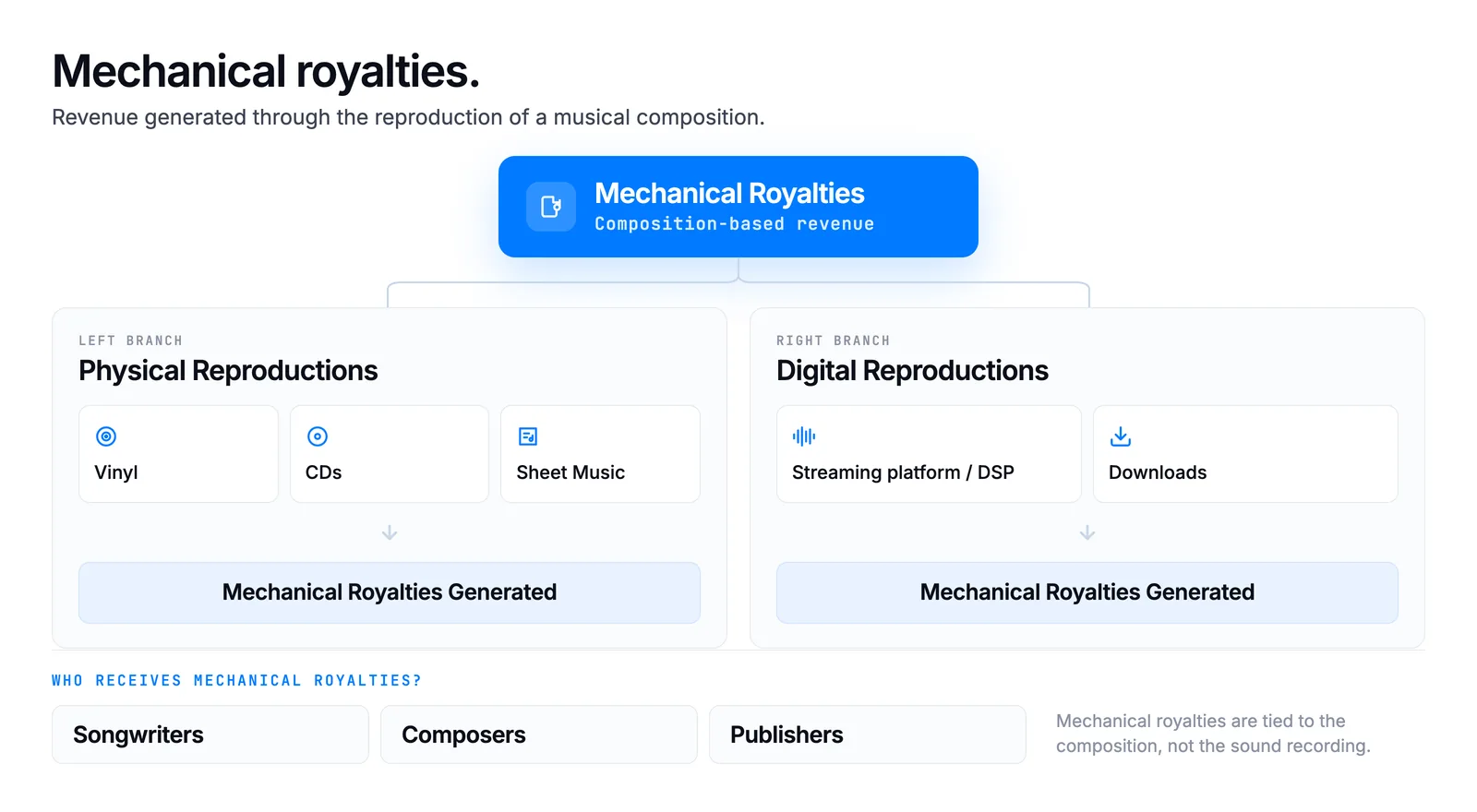
Mechanical royalties are generated whenever a musical composition is reproduced.
Historically, this referred to the physical reproduction of music on formats such as vinyl records, CDs, cassette tapes, and sheet music. In fact, the term mechanical originates from the early days of music reproduction, when compositions were reproduced through mechanical devices and physical carriers.
Today, mechanical royalties have evolved far beyond physical products. In many territories, they are also generated through digital uses of music, including downloads and certain forms of streaming.
What makes mechanical royalties unique is that they belong to the composition side of the business rather than the recording side.
This means that mechanical royalties are generally paid to:
- Songwriters
- Composers
- Music publishers
Depending on the territory, royalties may be collected and administered through publishers, publishing administrators, mechanical-rights organizations, or collecting societies.
Examples of activities that can generate mechanical royalties include:
- Streaming a song on a streaming service, like Spotify or Apple Music
- Downloading a track from a digital store
- Manufacturing vinyl records
- Producing CDs
- Reproducing sheet music
For publishers, mechanical royalties often represent one of the most important recurring revenue streams. For labels, understanding mechanical royalties becomes particularly important whenever publishing rights, licensing agreements, or integrated label-and-publishing operations are involved.
Performance Royalties
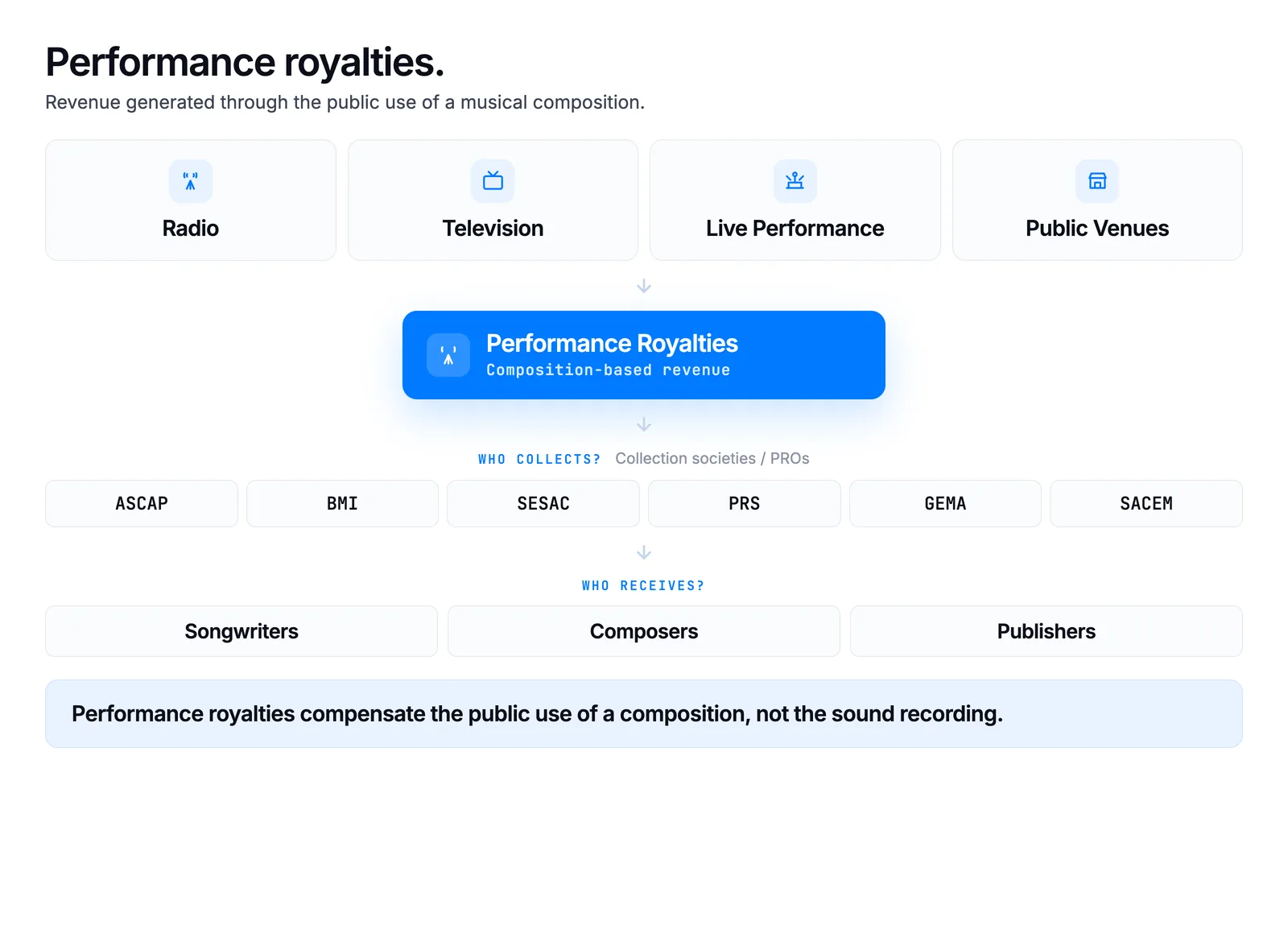
Performance royalties are generated whenever a musical composition is publicly performed or communicated to the public.
Unlike mechanical royalties, which are triggered by the reproduction of a composition, performance royalties are triggered by the public use of a composition.
Examples include:
- Radio broadcasts
- Television broadcasts
- Live performances
- Music played in bars, restaurants, and retail stores
- Public events
- In some territories, certain forms of digital streaming
Performance royalties belong to the composition side of the industry.
This means they are generally collected and distributed for the benefit of:
- Songwriters
- Composers
- Publishers
In most countries, performance royalties are administered by Performance Rights Organizations (PROs) or collection societies.
Examples include:
- ASCAP
- BMI
- SESAC
- PRS
- GEMA
- SACEM
For many songwriters and publishers, performance royalties represent one of the most important long-term revenue streams because songs may continue generating public-performance income for years or even decades after their release.
An important distinction is that performance royalties compensate the use of the composition, not the recording.
This becomes particularly relevant when distinguishing them from neighboring-rights royalties, which are linked to the use of the recording itself and the performers featured on that recording.
A radio station playing a commercial recording, for example, may generate:
- Performance royalties for the songwriter and publisher
- Neighboring-rights royalties for performers and recording owners (depending on territory)
The same playback event can therefore create multiple royalty obligations for different stakeholders.
Neighboring Rights Royalties
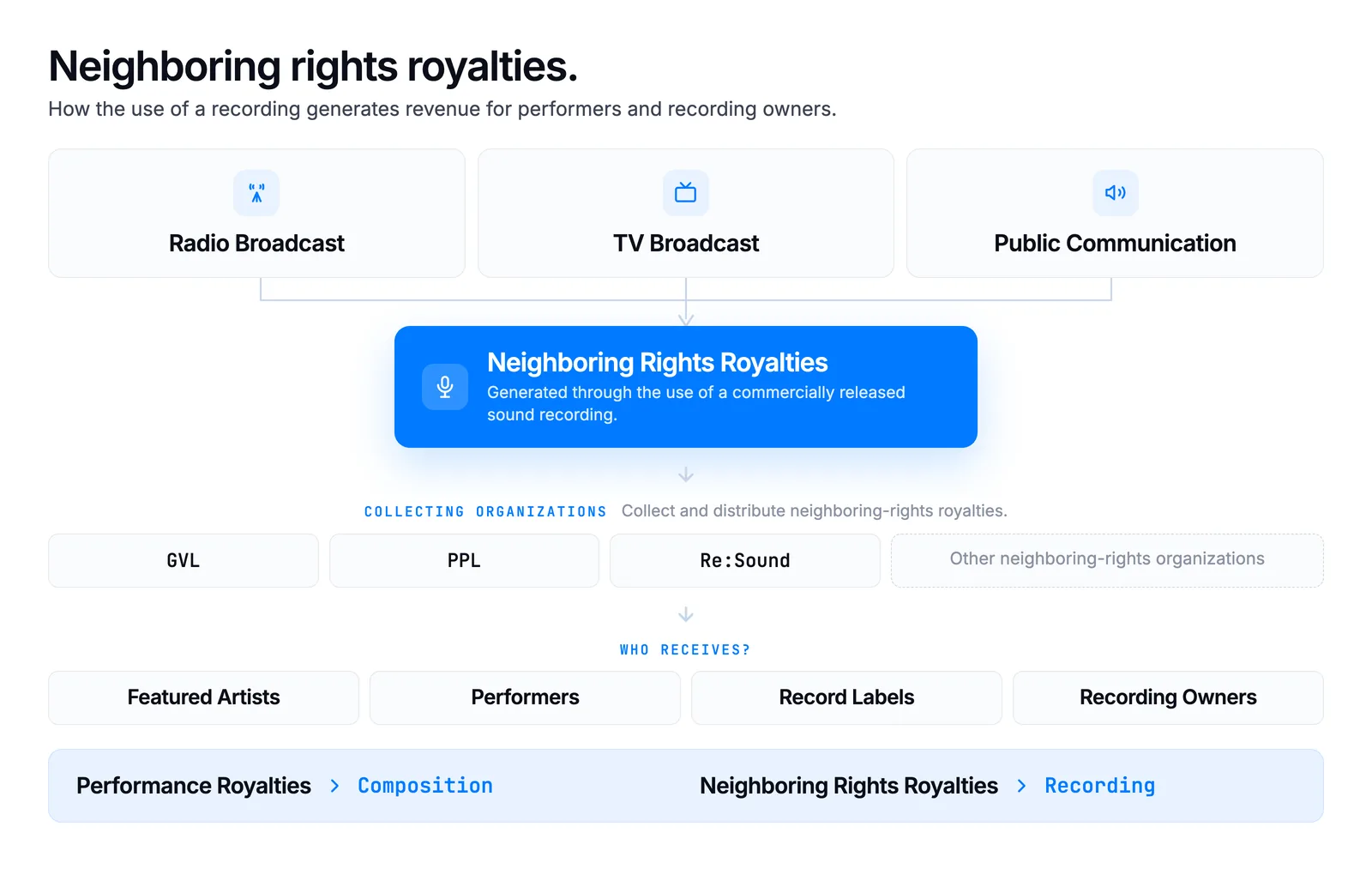
Neighboring-rights royalties are often confused with performance royalties because both are frequently triggered by the same event, such as a radio or television broadcast.
The key difference is that they compensate different rights holders for different rights.
Performance royalties compensate the owners of the composition:
- Songwriters
- Composers
- Publishers
Neighboring-rights royalties compensate the owners and performers of the recording:
- Featured artists
- Performers
- Record labels
- Recording owners
In simple terms:
If a radio station plays a song, there are two separate assets being used:
- The composition itself (lyrics and music)
- The sound recording of that composition
These two assets generate different royalty streams.
For example, when a commercially released recording is broadcast on radio:
- Performance royalties may be generated for the songwriter and publisher.
- Neighboring-rights royalties may be generated for the featured performer and the label that owns the master recording.
This distinction is one of the clearest examples of why music rights are often described as layered rights systems.
Unlike sync royalties, neighboring-rights royalties are generally not negotiated individually. Instead, they are usually collected and distributed by neighboring-rights organizations and collective management societies.
Examples include:
- GVL (Germany)
- PPL (United Kingdom)
- Re:Sound (Canada)
- Similar organizations in many other territories
Neighboring-rights income can be particularly valuable for labels and performers with strong radio, television, and public-performance exposure.
At the same time, it is often one of the most overlooked revenue streams because reporting, registrations, and collection mechanisms differ significantly between territories.
As international exploitation grows, neighboring-rights administration becomes increasingly important for both labels and performers seeking to maximize the value of their catalogs.
Sync Royalties
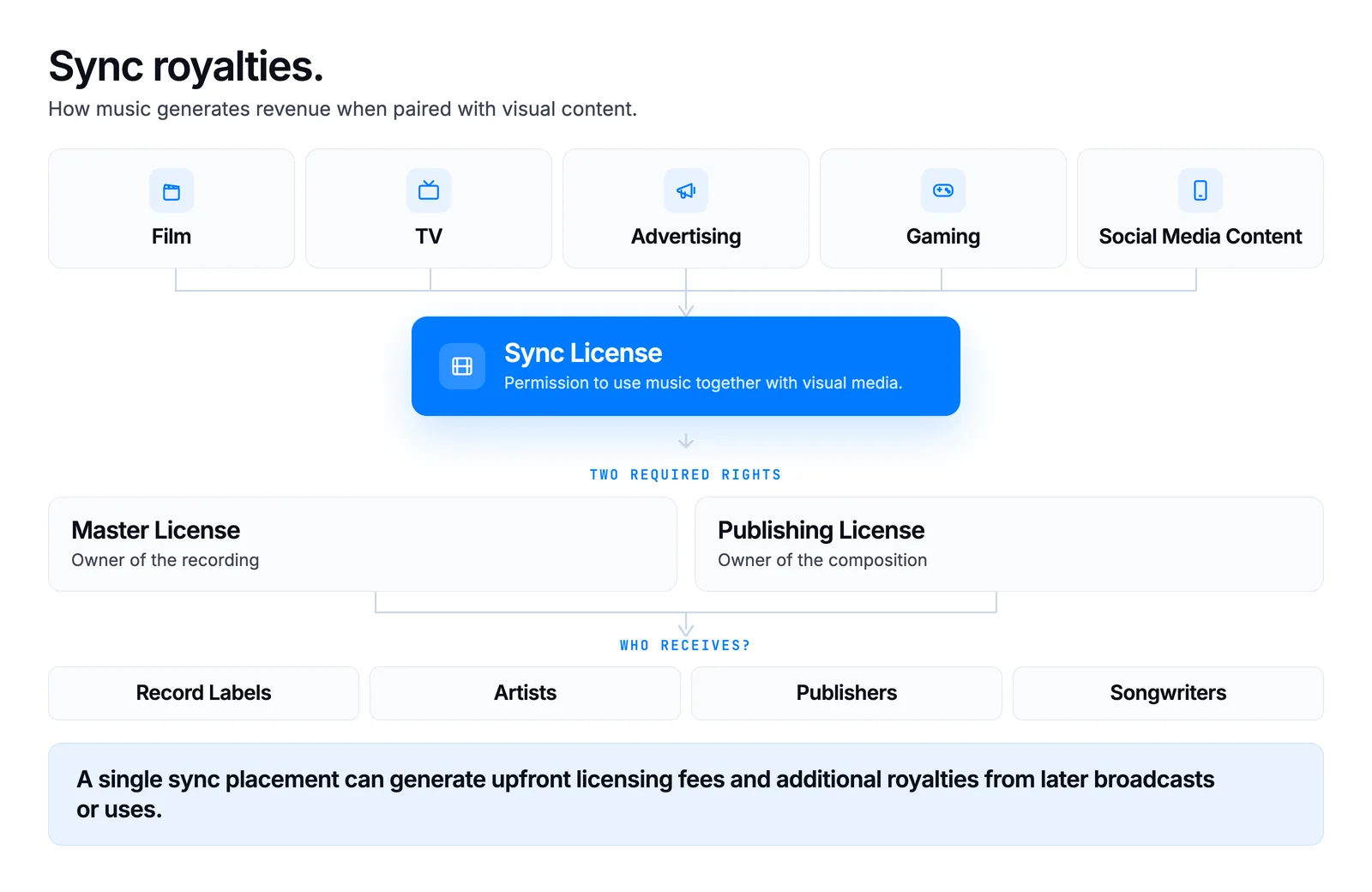
Sync royalties, or synchronization royalties, are generated when music is licensed for use together with visual content.
Unlike mechanical, performance, or neighboring-rights royalties, sync income does not originate from a platform report, broadcast log, or collecting society distribution. Instead, sync deals are typically negotiated directly between rights holders and licensees.
Examples include:
- Films
- Television productions
- Advertisements
- Video games
- Corporate videos
- Social media campaigns
- YouTube productions
- Streaming platform originals
The term "synchronization" refers to synchronizing music with moving images.
Because both the recording and the composition are involved, a sync license usually requires approval from multiple rights holders.
For example:
A production company wants to use a song in a Netflix documentary.
In many cases they must secure:
- A master license from the owner of the recording
- A publishing license from the owner of the composition
This means sync income can generate revenue for:
- Record labels
- Recording artists
- Publishers
- Songwriters
- Other contractual participants
Unlike other royalty types, sync fees are often negotiated individually.
The amount depends on factors such as:
- Type of production
- Duration of use
- Territory
- Audience size
- Exclusivity
- Budget of the production
As a result, sync deals can range from a few hundred dollars for a small online campaign to six- or even seven-figure licensing fees for major global productions.
Sync income is also unique because it frequently combines upfront payments with ongoing royalty opportunities.
For example, a song licensed for a television commercial may generate:
- A sync fee for the initial placement
- Performance royalties if the commercial is broadcast
- Additional income from international uses
This is why sync licensing is often considered one of the most valuable revenue opportunities available to both labels and publishers.
For rights holders with strong catalogs, a single sync placement can generate more revenue than millions of streams.
Conclusion
Although people often talk about "music royalties" as if they were a single source of income, the reality is much more nuanced.
Mechanical royalties, performance royalties, neighboring-rights royalties, and sync royalties are generated through different uses of music, collected through different channels, and distributed to different groups of rights holders.
A single song can generate several of these royalty streams at the same time, which is why understanding the distinction between them is essential for labels, publishers, artists, and songwriters alike.
The better you understand where each royalty originates, the easier it becomes to understand how music revenue flows through the industry.