
· 5 min read
How Are Music Royalties Collected? And When Does a Stream Become Reportable Revenue?
In our previous guide, we explained what music royalties are, who receives them, and how different types of music usage generate revenue.
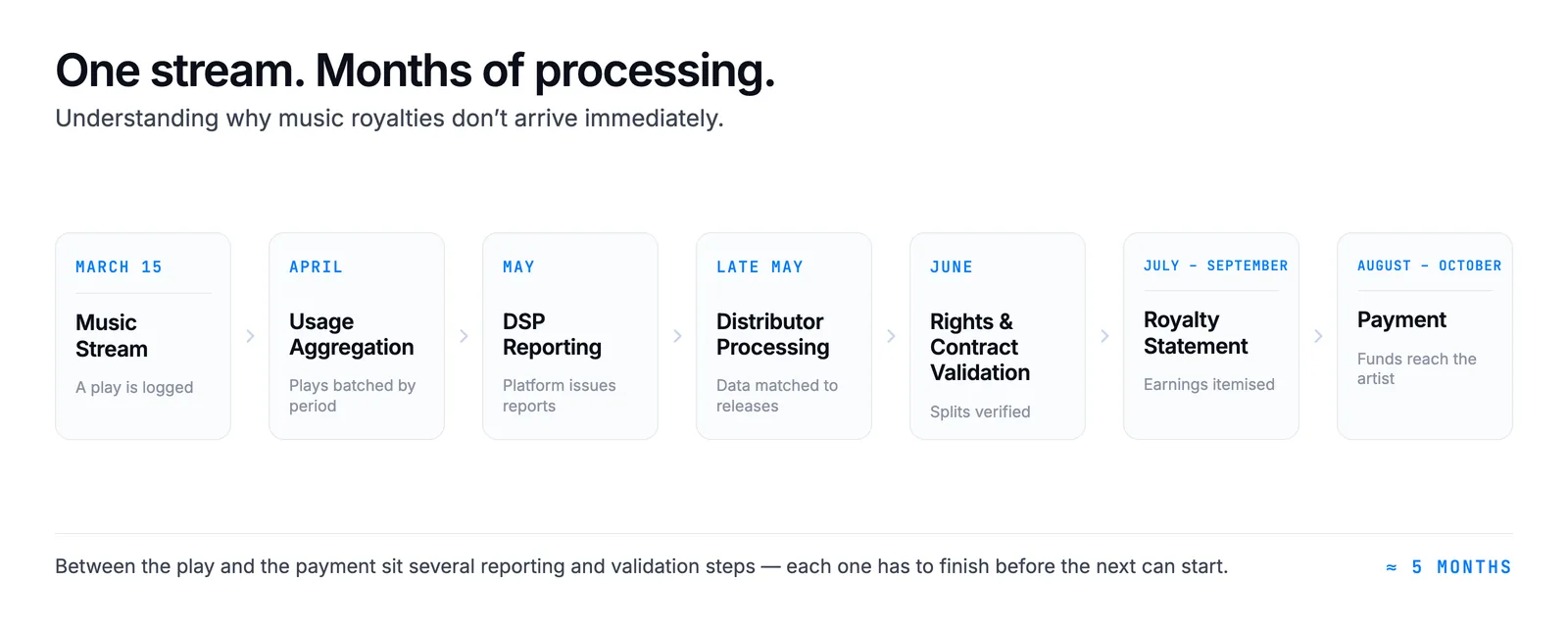
In our previous guide, we explained what music royalties are, who receives them, and how different types of music usage generate revenue.
However, one question remains:
If streaming happens in real time, why do royalty statements always seem to arrive months later?
The answer lies in the way royalty collection actually works.
A common misconception in the music industry is that royalties move directly from a streaming platform to an artist or rights holder. In reality, there are several reporting, validation, and accounting layers between a stream and a payment.
Understanding these layers helps explain why royalty statements are not real-time snapshots. They are historical documents built on reported and processed activity.
The Biggest Misconception About Music Royalties
Most people imagine a very simple process:
Stream 👉 Revenue 👉 Payment
The reality is very different.
Before revenue can appear on a royalty statement, several parties need to complete reporting and accounting processes. Streaming platforms first need to calculate usage and revenue allocations. Distributors then need to ingest and process reports. Labels and publishers need to validate the data, apply contract terms, and eventually generate statements.
As a result, a stream that happens today is rarely visible in a statement tomorrow.
Usage Date vs. Reporting Date
One of the most important concepts in royalty accounting is the difference between activity and reported activity.
For example:
- A listener streams a song in January.
- The streaming platform records the activity immediately.
- The platform does not instantly report that activity to rights holders.
- The activity first needs to be aggregated, validated, monetized, and included in a reporting cycle.
Only then does the usage become reportable revenue.
In other words, a stream may happen in January, but from an accounting perspective it may not become visible until March or April.
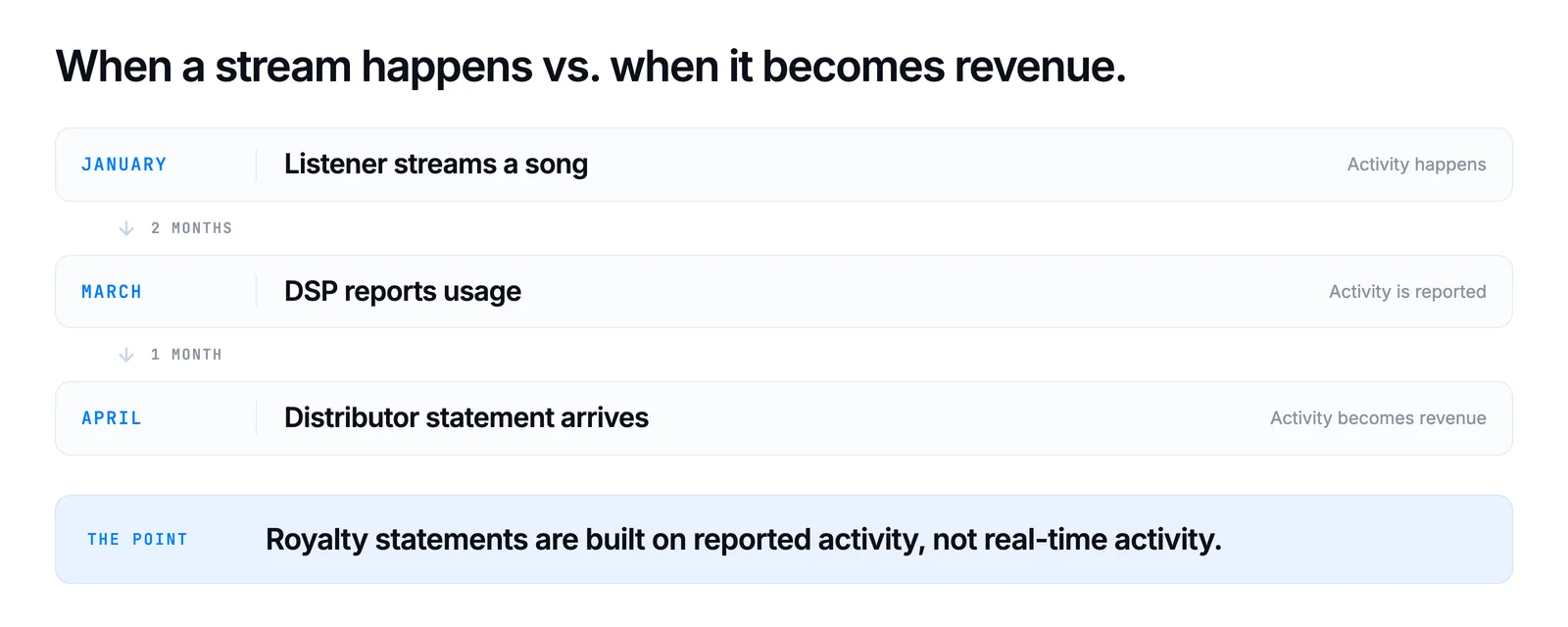
This distinction is incredibly important because many people compare real-time platform analytics with royalty statements and expect the numbers to align immediately. However, as shown, royalty statements are built on historical data, not real-time data.
Why Streaming Platforms Report With A Delay
The delay does not usually begin at the label or even the distributor. It begins much earlier.
Every month, digital service providers must process enormous amounts of data across territories, subscription plans, advertising models, currencies, and licensing agreements before creating royalty reports.
Different platforms operate on different reporting schedules.
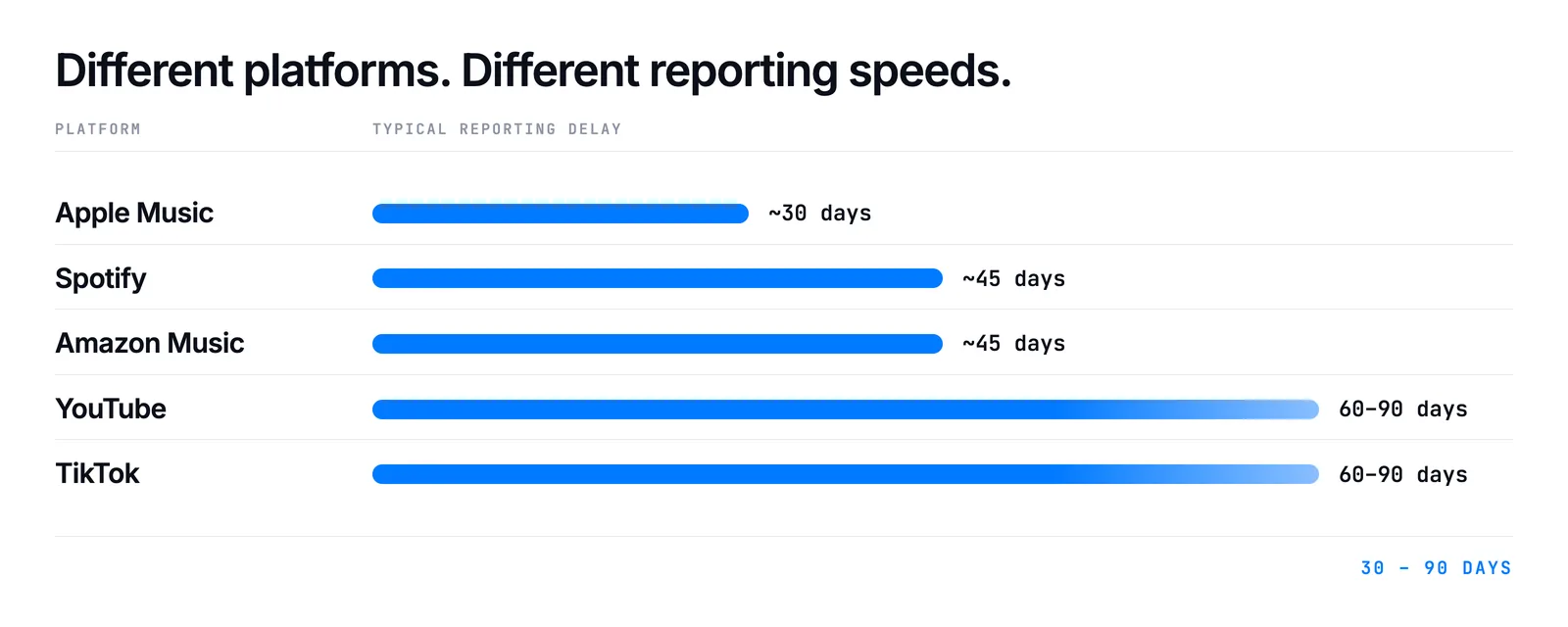
Typical reporting delays may look like this:
- Apple Music: approximately 30 days
- Spotify: approximately 45 days
- Amazon Music: approximately 45 days
- YouTube: approximately 60–90 days
- TikTok: approximately 60–90 days
This means that activity occurring in January may not be reported by certain platforms until March or even April. Only after these reports become available can distributors begin their own processing.
Why Distributor Reports and Label Statements Are Different Things
Another area of confusion is the difference between distributor reporting and label accounting.
Many distributors provide reporting on a monthly basis. This often creates the expectation that artists or rights holders should also receive monthly royalty statements.
In practice, these are two separate processes. Distributor reports are typically sales or revenue reports. They tell labels and publishers what activity was reported by streaming platforms and other revenue sources.
Label royalty statements, on the other hand, are accounting documents.
Before a label can generate a statement, several additional steps may be required:
- Data imports
- Revenue validation
- Rights verification
- Contract application
- Splits and royalty calculations
- Recoupment processing
- Currency conversion
- Financial review
As a result, many labels operate on:
- Quarterly reporting cycles
- Semi-annual reporting cycles
- Annual reporting cycles
The exact schedule depends on contractual obligations, catalog size, accounting resources, and internal processes.
This is why a rights holder may receive distributor reports every month but artists receive royalty statements only twice a year: The distributor delivers raw financial data, the label delivers an accounting outcome.
What Happens When Reports Reach a Label or Publisher?
Once distributor reports arrive, the operational work begins.
The incoming revenue is rarely ready for immediate distribution. Revenue must first be connected to the appropriate recordings, compositions, contracts, rights holders, and accounting structures. Modern music companies often process thousands or even millions of individual revenue lines before generating a statement.
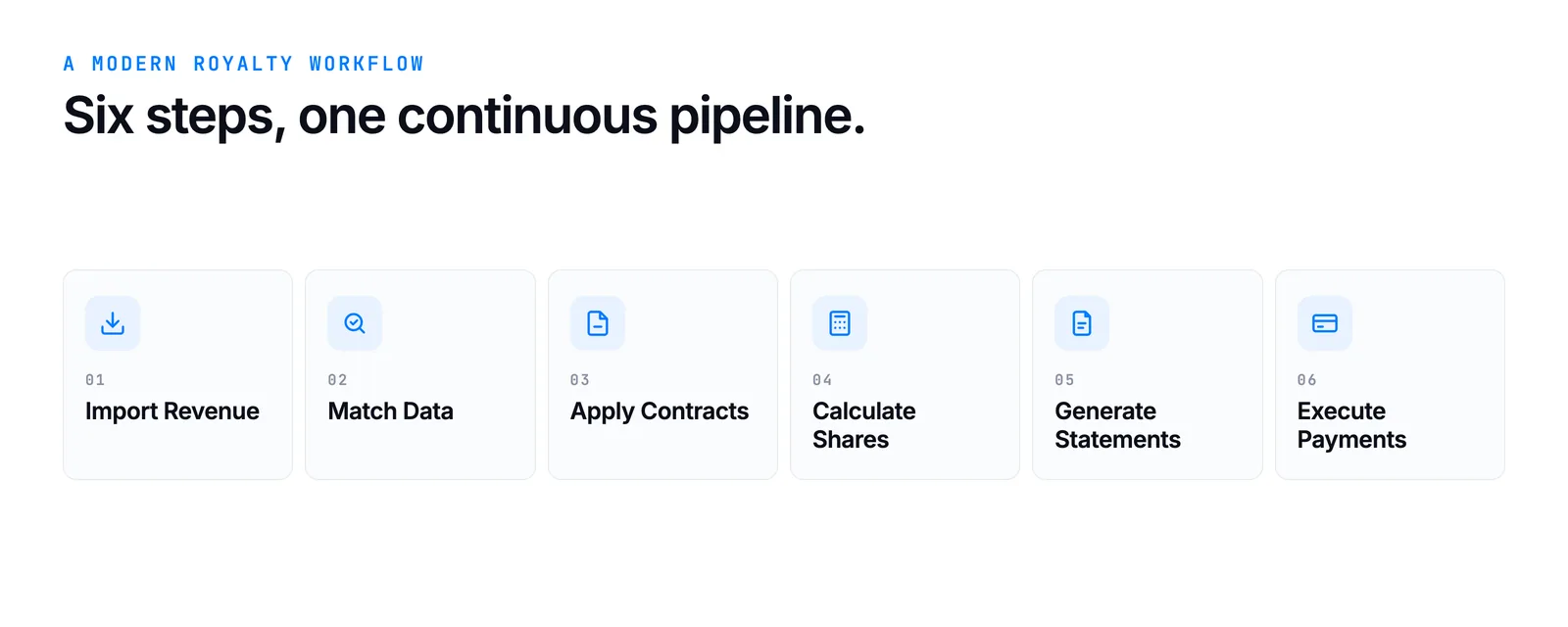
A typical workflow includes:
- Import revenue
- Match data
- Apply contracts
- Calculate shares
- Generate statements
- Execute payments
This process ensures that every revenue line is connected to the correct rights structure before any payment is made.
Why Transparency Matters
Because royalty reporting is inherently delayed, transparency becomes even more important. Artists, managers, songwriters, and rights holders want confidence that reporting is accurate and complete.
Clear communication about:
- Reporting periods
- Usage periods
- Statement periods
- Payment dates
helps reduce misunderstandings and disputes.
This is also why many modern music businesses increasingly invest in reporting dashboards, artist portals, and transparent statement delivery processes. When everyone understands where the data originates and how it is processed, trust increases throughout the royalty chain.
Conclusion
The biggest delay in music royalties usually does not happen inside a label. It happens before the data even reaches the label.
Streaming platforms first need to process and report usage. Distributors then need to deliver revenue reports. Labels and publishers must then validate, reconcile, calculate, and account for that information before statements can be generated.
As a result, royalty statements are not real-time reports. They are historical snapshots built on reported and processed activity.
Understanding this distinction makes it much easier to interpret royalty statements, compare them to platform analytics, and understand why a stream from January may not appear in an accounting system or statement until months later.